
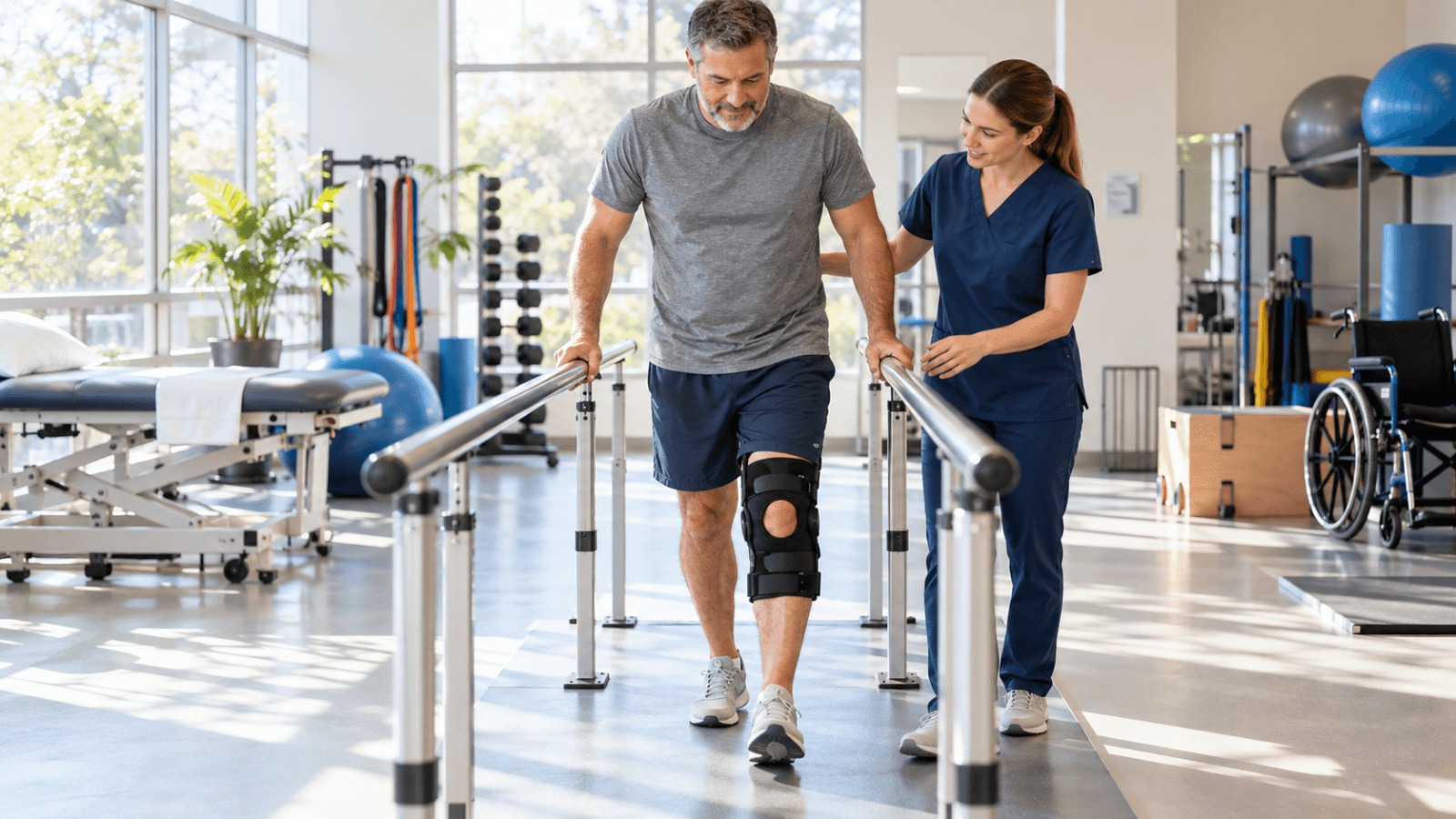
Surgery is often only the first part of treatment. After the procedure, the second phase begins — recovery.
For many patients, the period after surgery is the most uncertain. How much can I move? When can I start exercising? Is it normal for me to still feel pain? When will I be able to drive, work, walk without aids or return to sports again?The answers depend on the type of surgery, the patient's condition and the doctor's recommendations, but one thing is common to many cases: well-structured rehabilitation can be an important part of returning to normal function.
Why rehabilitation starts very early
After surgery, the body needs time to heal, but this does not mean that complete rest is always the best solution. In many procedures, rehabilitation begins very early, sometimes even the same day or the next day.Initially, these are not demanding exercises. The goal can simply be to get out of bed safely, use crutches properly, move the joint within the permissible range, or activate certain muscles. Early movement, when allowed, can help preserve function and reduce the consequences of prolonged dormancy.
Of course, the pace should always be adapted to the type of surgery and the surgeon's instructions.
Phase one: symptom control and safe movement
In the first days or weeks after the procedure, pain, swelling, numbness and feeling of weakness are often present. This can be an expected part of recovery. At this stage, rehabilitation often focuses on the basic goals: reducing swelling, maintaining circulation, safe movement and gradually restoring basic mobility.If the lower limb has been operated on, the patient may need to learn to use crutches or other aids properly.
After shoulder surgery, for example, the limits of movement and load specified by the surgeon should be observed. It is important to understand that at this stage the goal is not to “push through the pain”, but to allow the body a safe start to recovery.
Loss of power can happen quickly
After surgery, there may be a decrease in muscle strength very quickly. Part of this is associated with less activity, and part with the body's reaction to the operation itself. The patient may feel that his leg is "not listening", that the arm is extremely weak or that he is tired quickly.
That is why rehabilitation often involves early muscle activation, even when movement is not yet fully restored. Later, the exercises are gradually intensified to restore the strength needed for daily activities.
Stage two: restoring mobility
After many operations one of the main goals is to gradually restore the range of motion. The joint may be stiff due to swelling, pain, immobilization, or because the patient has not used it normally for some time. It is important to distinguish between safely increasing mobility and forcing.
An overly aggressive approach does not necessarily mean a faster recovery.A physical therapist can help determine how much movement is appropriate at a particular stage and how to progress gradually without undue strain on tissues that are still whole.
Stage three: return of strength and stability
When the early stage of recovery passes and the surgeon allows a greater load, rehabilitation becomes more active. Then exercises are introduced that develop strength, stability and movement control.In knee surgery, this may include strengthening the muscles of the thigh and hip. In shoulder surgery, the focus may be on the muscles that stabilize the shoulder and scapula. In spinal surgery, the emphasis may be on gradually restoring torso strength and normal movement patterns.
The goal is not only to be able to move the operated part again, but to be able to withstand the demands of everyday life.
Back to walking, work and daily activities
For many patients, the most important question is not how much the joint can bend, but when it will be able to live normally again.
When can I walk without crutches?
When can I drive?
When can I go to work?
When can I sleep on the operated side again?
Responses vary depending on the procedure. Rehabilitation should therefore include activities that are really relevant to the patient.If a person has to use stairs on a daily basis, rehabilitation should gradually prepare the body for this task. If the job involves standing or lifting a load for a long time, returning to work may require a different preparation than an office job.
Why it's not good to compare yourself to others
One of the most common mistakes after surgery is comparing your own recovery to someone else's.
“He was already walking normally after a month.”“My friend had almost no pain.”
“Someone on the internet went back to running long before me.”
Such comparisons can be very misleading. The speed of recovery depends on the type of procedure, age, previous condition, activity level, health condition and possible complications. Two people who have had a similar operation do not have to have the same course of rehabilitation.
It is much more useful to track your own progress over time.
Recovery is not always linear
Some days can be better and others worse.
After more demanding therapy or increased activity, more fatigue or discomfort may occur. This does not automatically mean that rehabilitation has gone in the wrong direction. It's important to look at the broader trend.Is mobility better than two weeks ago? Can you walk longer? Need less help? Is the power returning? Such indicators are often more useful than a one-day estimate.
When to see a doctor
Although pain, swelling, and fatigue are often part of early recovery, certain symptoms should be taken seriously.If symptoms worsen abruptly, if marked redness, fever, severe swelling, wound problems, shortness of breath or other unusual symptoms occur, a doctor should be contacted.
Physiotherapy does not replace medical supervision after surgery. Good rehabilitation is carried out in accordance with medical instructions and restrictions.
Going back to sports requires more than just the disappearance of pain
Athletes often want to know when they can return to training. The disappearance of pain is not a sufficient criterion.
Before returning to sport, it is often necessary to restore sufficient strength, stability, coordination and the ability to withstand a higher load. The person must be prepared for the movements that really occur in the sport: sprinting, jumping, changing direction, contact or repetitive movements.That is why the last phase of rehabilitation can look very different from the first. From simple exercises, in the beginning, there are more and more specific and demanding tasks.
Good recovery requires patience and structure
After surgery, it is easy to go to one of two extremes. Some people are afraid to move and avoid activities for too long. Others want to continue as before and try to speed up the process as soon as possible. Neither is ideal. Good rehabilitation is based on gradual progression.The goal is not to be as fast as possible. The goal is to restore function safely and sustainably. Surgery can solve a certain medical problem, but rehabilitation often determines how well a person will return to daily activities after the procedure.
If you are preparing for surgery or are already recovering after the procedure, you can find physical therapy and rehabilitation professionals on the Energy Clinic platform who can help you structure a safe and individually tailored recovery.