Until recently, wellness was primarily associated with massages, saunas, thermal baths and relaxing treatments. Today, there is more and more talk about something we cannot see, but it strongly affects our daily functioning – the nervous system. Neurowellness is one of the most interesting trends in the world of health and medical wellness in 2026. His main idea is to help the body respond better to stress, recover better and move more easily from a state of tension to a state of relaxation.
From specialized clinics to nerve-stimulating portable devices, a whole new category of treatments is being developed.Interestingly, these methods are no longer available only abroad. Neurofeedback and related approaches are already being applied in several Croatian health and specialized institutions.
But what exactly is neurowellness and can technology help us better manage stress?
What is neurowellness?
Neurowellness is a broad term that encompasses methods aimed at regulating the nervous system, relaxing and improving the psychophysical sense of well-being.
In order to understand its popularity, it is necessary to get to know the autonomic nervous system.
It manages many processes that take place without our conscious control, including heartbeat, digestion, and certain aspects of breathing.Its two important components are the sympathetic and parasympathetic nervous systems.
The sympathetic system participates in preparing the body for activity and facing challenges, while parasympathetic supports rest, digestion and recovery.
Both are necessary for normal functioning.
The goal of the neurowellness approach is not to completely eliminate stress, but to improve the body's ability to adapt to everyday challenges and recover after a load.
**1. Neurofeedback – Technology-Assisted Brain Training **
One of the most well-known methods in the field of neurowellness is neurofeedback.
It is a non-invasive technique that uses brain activity measurement and feedback to help a person learn to regulate certain patterns of brain activity.
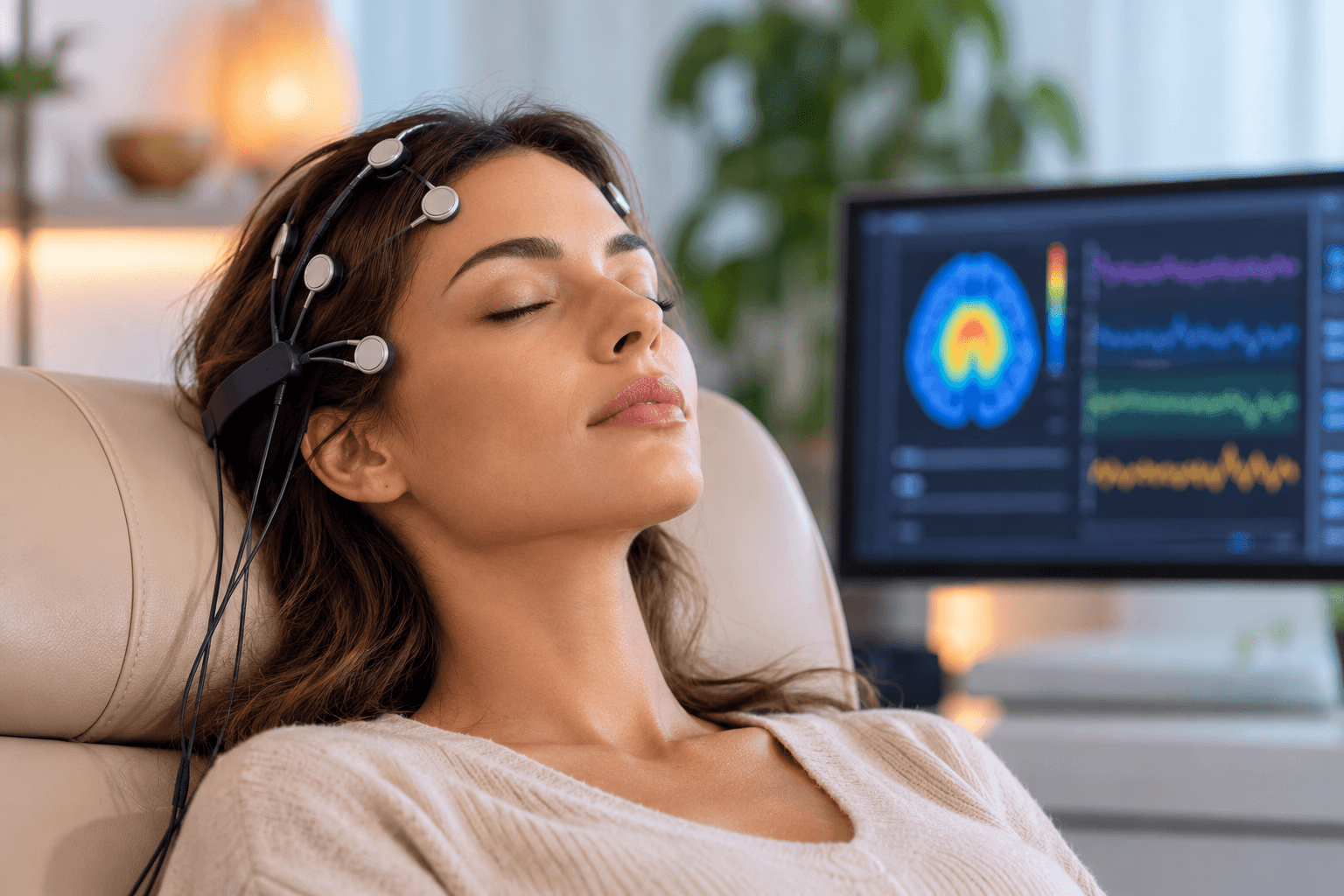
During treatment, sensors are placed on the scalp that record electrical activity using EEG technology.The collected data is processed by a computer program, and the person receives feedback through an image, sound or animation.
For example, it can watch a movie whose picture or sound changes depending on the recorded brain activity.
The goal is to encourage the learning of certain patterns of self-regulation through repetition.
Neurofeedback is investigated in areas such as attention, stress management, sleep, and certain neuropsychiatric difficulties.It is important to emphasize that the scientific evidence is not equally strong for all applications and protocols and that the method is not a universal substitute for standard treatment.
2. Vagus nerve stimulation – can an electrical impulse help to relax?
The vagus is one of the most important nerves of the autonomic nervous system. It connects the brain to a number of organs, including the heart and digestive system.Electrical stimulation of the vagus nerve is already used in medicine for certain medical conditions, such as some forms of epilepsy.
More recently, non-invasive devices have also appeared, which are placed on the neck or outer part of the ear.
Their manufacturers often point out the potential benefits for relaxation, stress management, and sleep quality.Although this technology is being actively researched, it is necessary to distinguish medically approved devices for certain diseases from commercial wellness products.
Evidence on the effectiveness of individual devices for general well-being improvement is still limited.
**3. HRV biofeedback – when breathing becomes a recovery tool **
One of the more affordable methods associated with neurowellness is HRV biofeedback.HRV, or heart rhythm variability, describes changes in the time intervals between heart beats.
This indicator is influenced by breathing, age, physical condition, health status and many other factors.
During HRV biofeedback treatment, the sensors monitor the heartbeat, while the person exercises slower and more regular breathing with expert instructions.
The goal is to learn to recognize certain physiological reactions and influence them.Research suggests that HRV biofeedback can help reduce subjective feelings of stress and anxiety, although results depend on protocol and population.
It is especially interesting because it connects modern technology with simple and accessible technique – breathing.
4. Somatic techniques – relaxation without expensive devices
While one part of the neurowellness industry develops advanced technology, the other emphasizes simpler methods.Somatic approaches focus attention on body sensations, breathing, movement and recognition of tension.
In wellness centers, this may include guided breathing exercises, light movements, meditation, and muscle relaxation techniques.
The advantage of such methods is that many do not require special equipment and can be included in everyday life.Certain relaxation techniques have a scientific basis to reduce stress, but popular claims of a complete “nervous system reset” are not medically accurate.
5. Where to try neurofeedback in Croatia?
Although neurowellness is a relatively new term, some methods associated with this trend are already available in Croatia.Particularly prominent is neurofeedback, which is applied in private health institutions, psychological centers, but also in the public health system.
SILAB Polyclinic in Zagreb offers neurofeedback according to the Othmer method for children and adults.
During the treatment, brain activity is monitored, and feedback is displayed through visual or audible content.According to the information of the polyclinic, the treatments last approximately 30 to 45 minutes, and the program is adapted to the needs of the individual.
According to the published price list, an individual treatment for adults is 45 euros, while a package of ten treatments costs 405 euros.
Location: Gradišćanska ulica 36, Zagreb.
Vita Plena is a specialized clinical and educational neurofeedback center that has been dealing with this method since 2014.
The center is focused on the training of self-regulation of brain activity, psychological counseling and education of experts.
Their approach includes individually tailored programs according to the needs of users.
Vita Plena is an example of how neurofeedback in Croatia is also developed outside traditional medical institutions.Location: Dubravica 41 F, Zagreb.
### ** Lopača Psychiatric Hospital – Rijeka area **
An interesting example also comes from the public health system.
During 2026, the Lopača Psychiatric Hospital introduced neurofeedback in its offer of diagnostic and therapeutic procedures.
The Othmer method is applied in the hospital, and the treatments are carried out by a further educated psychologist.According to the hospital, the individual treatment lasts approximately 30 minutes, while the program usually consists of multiple arrivals.
Prior psychiatric examination and evaluation of the indication is required for inclusion in the treatment.
This example shows that neurofeedback is not only present in the commercial wellness industry, but is also considered as part of wider healthcare.Important: These institutions offer neurofeedback, but not necessarily all other neurowellness methods described in the article. The availability of services, indications and prices should be checked directly with the service provider.
6. How to choose the right treatment?
Before choosing a neurowellness treatment, it is important to understand what it aims to achieve.People who want to improve their daily stress management can start with simple methods such as guided breathing, physical activity, and relaxation techniques.
For long-term insomnia, severe anxiety or other health problems, an expert medical evaluation is recommended.When choosing a neurofeedback or biofeedback, it is useful to inquire about the qualifications of the therapist, the expected results, the number of treatments required and the scientific basis for the specific indication.
No technology can guarantee the same result to all users.
The future of medical wellness is focused on recovery
Neurowellness represents an interesting change in the way we think about health.Instead of constantly emphasizing productivity and physical results, increasing attention is paid to recovery, quality sleep and the body's ability to adapt to everyday challenges.
Neurofeedback, HRV biofeedback and vagus nerve stimulation open up new possibilities, but their value should be assessed on the basis of reliable scientific evidence.Examples from Zagreb and the vicinity of Rijeka show that certain technologies related to this trend are already being applied in Croatia.
The future of wellness may not be about doing more for our health, but learning to rest and recover better.
Explore medical wellness, rehabilitation and integrative medicine providers on the Energy Clinic platform and find an approach that fits your needs.