
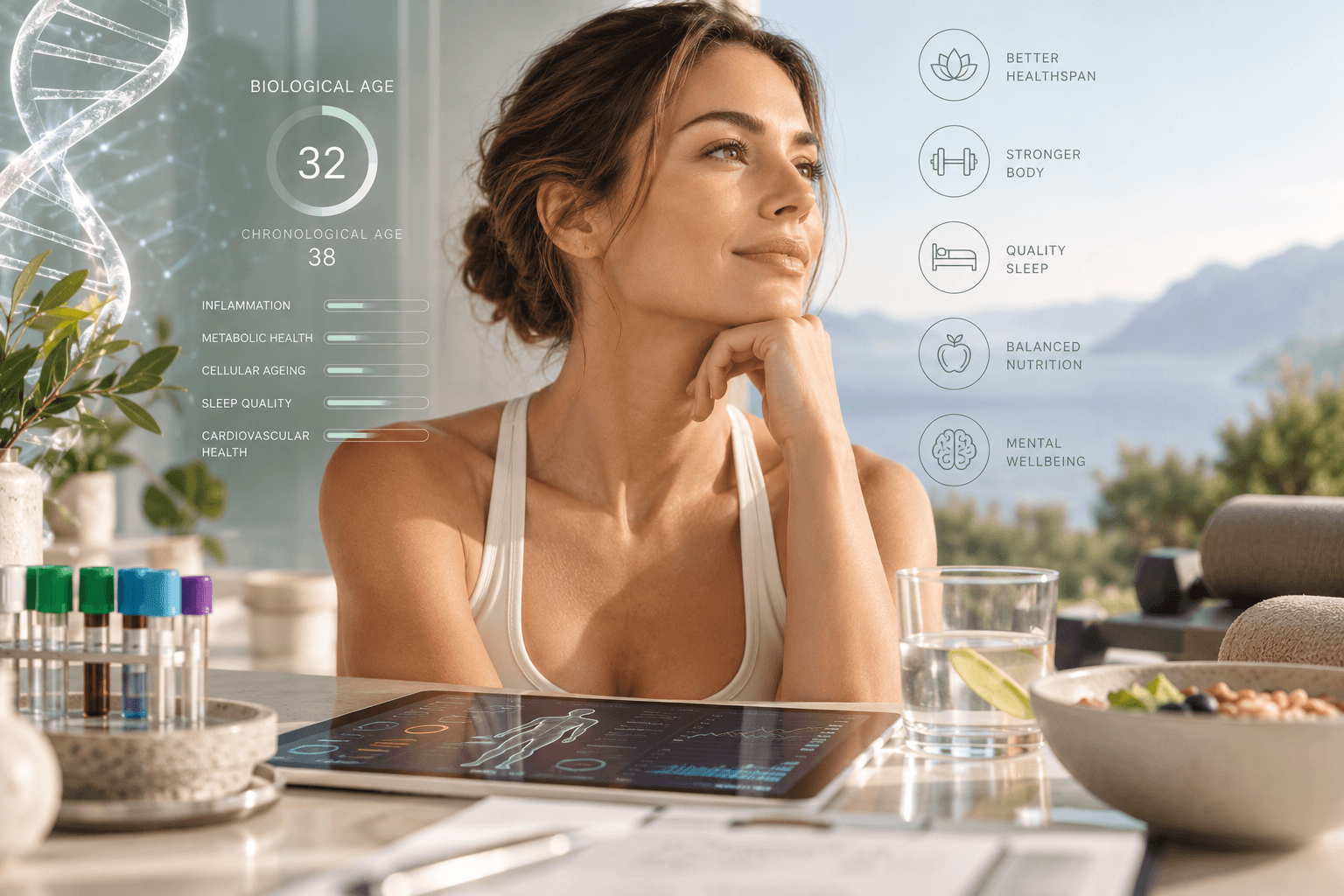
How old are you, really? The answer may not be as simple as your date of birth.
Two people of the same chronological age may have a very different health condition, physical condition and risk of developing the disease. It is on this difference that one of the most interesting trends in modern medicine is based – longevity medicine.Specialized centers are being opened worldwide that combine advanced diagnostics, biomarker analysis, personalized nutrition, physical activity, and health monitoring technologies.
The goal is not only to live longer, but to extend the period of life spent in good health.
But how much has already been scientifically proven, and how much belongs to the future of medicine?
What exactly is longevity medicine?
The term longevity means longevity, but the modern medical approach encompasses much more than just the number of years of life.
The focus is on the concept of healthspan – a period of life during which a person retains good physical and mental health, functionality and independence. Unlike the traditional anti-aging approach, which is often focused on the external appearance, longevity medicine seeks to understand the processes associated with aging and the factors that increase the risk of disease.
The emphasis is on prevention, early recognition of health risks and long-term lifestyle changes.
1. Biological age – more important than the number of candles on the cake?
One of the most popular terms in longevity medicine is biological age.
While chronological age simply indicates the number of years since birth, biological age attempts to assess the state of the organism based on certain physiological and molecular indicators.
Today, there are tests that analyze a variety of biomarkers, including certain DNA methylation patterns, blood indicators, and other aging-related data.Such analyses can provide an interesting insight into biological processes.
However, biological age is not a unique, precisely established medical value. Different tests can produce different results, and their ability to predict health outcomes is not equally well confirmed.
Therefore, the test result should not be viewed as a final judgment on one's own health.
2. Longevity Clinics – the new generation of medical wellness
Specialized longevity centers are becoming more prevalent in Europe, the United States, and Asia.
Some offer multi-day programs that include health assessments, laboratory analysis, nutritional counseling, physical activity, sleep optimization, and recovery procedures.
The most famous centers try to connect medical diagnostics with the experience of luxury wellness.
However, not every treatment offered is equally justified. While quality nutrition, regular physical activity and treatment of established health problems have a strong scientific basis, certain infusions, supplements and experimental procedures do not yet have convincing evidence to prolong human life.
A quality longevity program should clearly distinguish proven medical care from procedures whose effectiveness is still being investigated.
3. Can blood tests reveal how we age?
Advanced blood analysis is becoming an important part of the longevity center offer.
In addition to standard indicators, individual institutions analyze a large number of biomarkers related to metabolism, inflammatory processes, hormonal status and other functions of the body.
Such data can help physicians assess certain health risks.
However, more analysis does not automatically mean better quality health care. Excessive testing of healthy individuals can lead to false positives, unnecessary additional tests, and concerns.
The greatest value of diagnostics is not in the amount of data collected, but in their proper interpretation and the ability to make useful medical decisions.
4. Muscle mass becomes a new symbol of healthy aging
One of the more important changes in the approach to longevity is the increasing attention paid to muscle strength. With age, muscle mass and function gradually change, which can affect mobility, balance and the ability to live independently.
That's why strength training is becoming an important part of a healthy aging program.
In addition to preserving muscles, regular physical activity contributes to bone health, metabolism, cardiovascular health and functional ability.
This is one of the best-established strategies for preserving vitality.
5. Sleep and Recovery – A New Priority for Medical Wellness
Sleep quality is increasingly viewed as an important indicator of health.
Smartwatches and other wearable devices allow you to monitor sleep duration, activity and certain physiological parameters.
Such data may be useful for pattern recognition, but is not a substitute for medical diagnosis of sleep disorders. At the same time, there is a growing interest in recovery programs that include relaxation techniques, stress management, thermal treatments, and individually tailored physical activity.
While the benefits of quality sleep and regular movement are well known, claims that certain wellness treatments can slow biological aging require additional evidence.
6. Can we really slow down aging?
Scientists are intensively investigating the mechanisms of aging, including changes in cellular function, chronic inflammation, metabolism, and epigenetic processes.
Potential therapies that could someday affect certain biological mechanisms associated with aging are also being investigated.
However, there is currently no proven treatment that can reliably stop or reverse the entire human aging process.The best confirmed strategies for healthier aging continue to include a balanced diet, regular physical activity, sufficient sleep, avoiding smoking, and appropriate preventive health care.
The future of medical wellness
Longevity medicine represents an interesting shift towards a more personalized and preventive approach to health. The development of diagnostic technologies and a better understanding of biological processes open up new opportunities, but at the same time require critical reflection.
The most expensive test is not necessarily the most useful, just as the latest technology is not automatically better than proven methods.
The true value of the longevity approach lies not in the promise of eternal youth, but in the ability to preserve the quality of life for as many years as possible.Explore the world of medical wellness, rehabilitation, and modern approaches to health at Energy Clinic.