
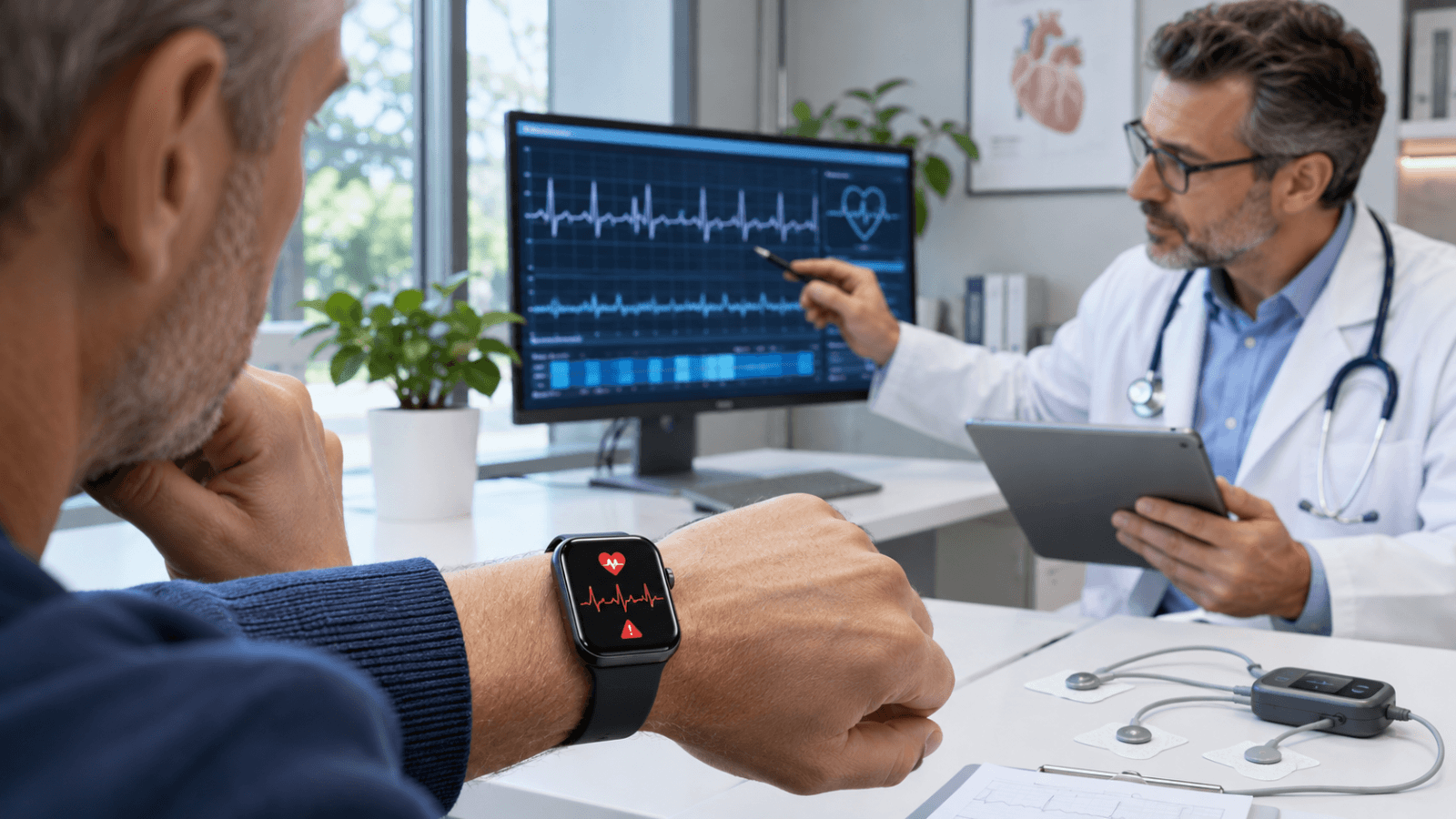
Imagine that in the middle of an ordinary day, your smartwatch displays a notification: "An irregular heart rhythm has been detected." You have no pain, you don't feel unwell, and you wonder if the device is wrong.
This is where digital technology and modern cardiology meet. The watch can detect an abnormality, but a medical assessment is needed to answer the question of what is happening to the heart.
1. How does the watch detect an irregular rhythm?
Most devices use an optical sensor that uses light to measure changes in blood flow under the skin. This measurement is called photoplethysmography (PPG).
Some watches can also record a short single-channel electrocardiogram (ECG). The algorithms then look for patterns that may indicate rhythm abnormalities, particularly atrial fibrillation.
However, hand movements, the position of the watch, and other factors can affect the reading. An alert is not a diagnosis, and the absence of an alert does not mean that the heart is definitely healthy.
2. Why is atrial fibrillation important?
Atrial fibrillation is a common heart rhythm disorder that can cause palpitations, fatigue, shortness of breath, or dizziness. In some people, it goes almost unnoticed.
It is important to detect it because it is associated with an increased risk of stroke. However, not every skipped heartbeat is atrial fibrillation, and not every irregular heartbeat is a sign of a serious illness.
According to the guidelines of the European Society of Cardiology, a suspicion obtained by an optical sensor must be confirmed by an appropriate ECG recording evaluated by a specialist.
3. What does technology bring in 2026?
In addition to smartwatches, ECG patches, wearable sensors, and systems that use artificial intelligence to analyze longer heart rhythm recordings are being developed.
The goal is not only to collect more data, but also to make it easier to identify occasional changes that could be missed in a brief examination.
The research is promising, but the usefulness depends on the quality of the measurements and the correct interpretation of the results.
4. Why is Holter ECG still important?
A standard ECG shows the heart's activity over a short period of time. If irregularities occur once every few days, the findings in the doctor's office may be normal.
A Holter ECG records the electrical activity of the heart during daily life, most often for 24 or 48 hours, and, if necessary, for longer.
The patient can record the moments when they experience discomfort so that the doctor can compare the symptoms and the recorded rhythm.
Longer monitoring is not automatically better for everyone: the duration is determined by the doctor based on the symptoms and the reason for the test.
5. Where can a Holter ECG be performed in Croatia?
The Energy Clinic Guide presents several institutions that offer this test in different parts of Croatia:
Došen Polyclinic, Karlovac – Holter ECG up to 72 hours.
Polyclinic Dr. Džumhur, Osijek – 12-lead Holter ECG for up to seven days.
Radaković Practice, Poreč – monitoring from 24 hours to 15 days.
Croatia Polyclinic, Rijeka – 24-hour heart rhythm monitoring.
Polyclinic Dr. Dadić, Split – Holter ECG for up to seven days.
EL Medical Polyclinic, Virovitica – monitoring for up to seven days.
Medikol Polyclinic, Zagreb – Holter ECG from 24 to 96 hours.
The duration and availability of the test must be confirmed directly with the institution. More options can be found in the Cardiology category at Energy Clinic.
6. When to seek help?
If the watch repeatedly warns of an irregular rhythm or if you experience palpitations, skipped beats, unexplained fatigue, or dizziness, consult a doctor. Keep the record from the watch if available.
Severe chest pain, difficulty breathing, or loss of consciousness require immediate medical attention.
Conclusion: A smartwatch can be the first signal, but it is not a substitute for diagnosis. It is most useful when it prompts a timely, professionally guided check-up of heart health.
Not sure what suits you?
Find the right provider for you with our AI tool →