
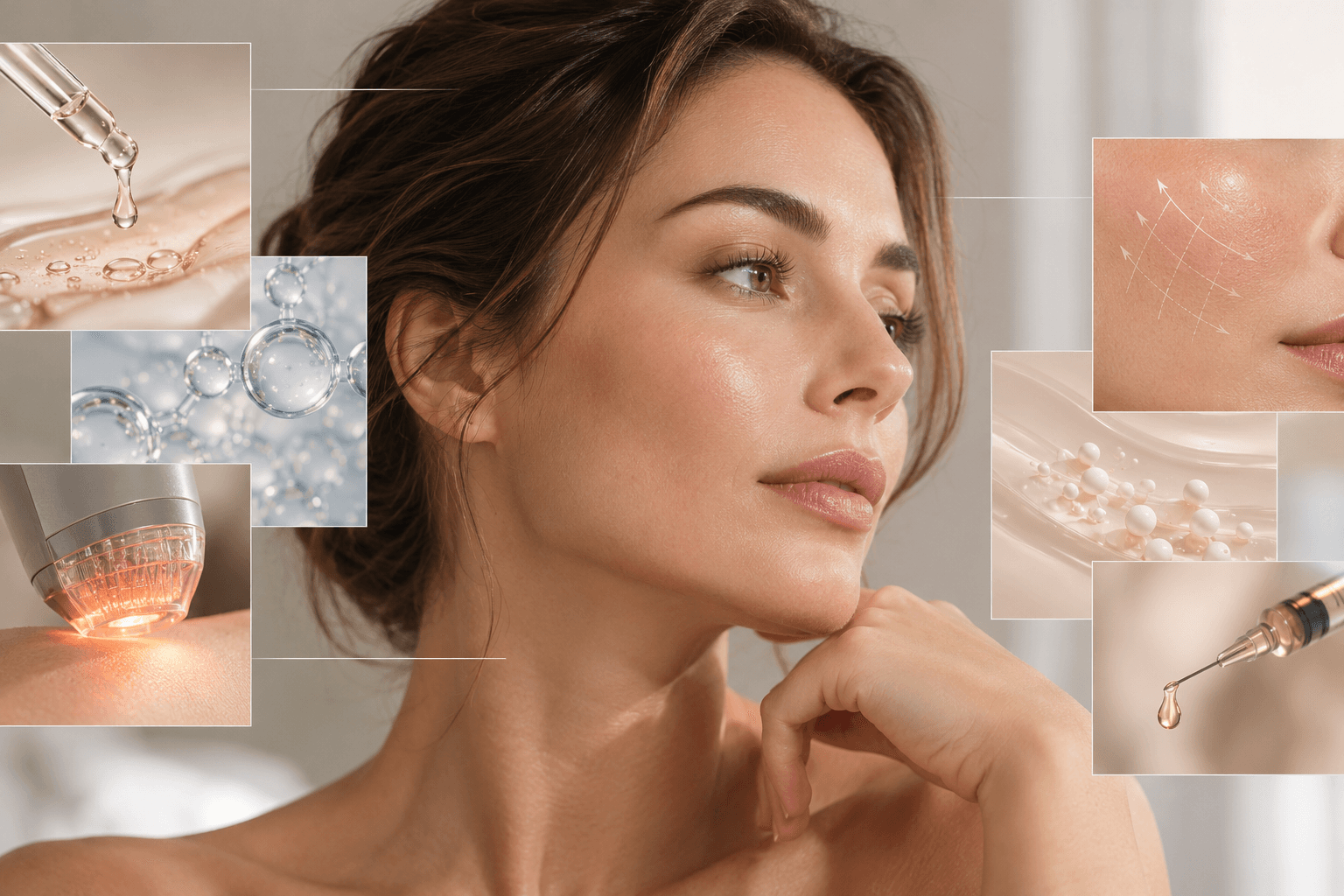
For years, hyaluronic fillers have been one of the most popular aesthetic treatments. They were used to accentuate lips, shape cheekbones, relieve wrinkles, and restore lost facial volume.
Today, there is more and more talk about a different approach to aesthetics. Instead of adding volume, emphasis is placed on improving skin quality, stimulating collagen and preserving natural facial features.At the center of attention are treatments that promise gradual, subtle results without a pronounced filling effect.
What are the most interesting alternatives to traditional fillers in 2026?
1. Sculptra – stimulation of your collagen
Sculptra is one of the most famous biostimulation treatments. Its main ingredient, poly-L-lactic acid (PLLA), promotes the gradual formation of collagen in the skin. Unlike hyaluronic fillers that provide almost instantaneous volume, Sculptra treatment results evolve over weeks and months.
The skin may look firmer over time, and the lost volume is gradually compensated.
Results may last up to approximately two years, depending on individual characteristics and treatment protocol. Who is it for? People who want to gradually restore volume and improve the appearance of the skin, without abruptly changing facial features.
It is important to know that Sculptra is also a type of injectable filler, but it works differently from classic hyaluronic fillers.
**2. Radiesse – collagen volume and stimulation **
Radiesse is based on calcium hydroxyapatite (CaHA), a material used in aesthetic medicine to replenish volume and stimulate collagen formation.
Its peculiarity is a double effect: it can provide immediate structural support, while the effects of biostimulation develop gradually.
In certain protocols, diluted preparations are used to improve the quality of the skin and its firmness. Radiesse may be considered for specific areas of the face and hands, depending on the indication and the approved use of the product.
Unlike hyaluronic fillers, calcium hydroxyapatite cannot simply be dissolved by hyaluronidase.
Therefore, the choice of the patient, the correct technique and the experience of the doctor are especially important.
**3. Polynucleotides – a regenerative approach to skin care **
One of the most interesting trends in aesthetic medicine involves polynucleotides, also known as PN and PDRN.
These are compounds derived from DNA fragments, which are investigated for their potential impact on skin repair processes.
Polynucleotide treatments are most often focused on hydration, elasticity, texture and general skin quality.
They attract special attention in the treatment of more sensitive areas, such as the skin around the eyes. However, polynucleotides do not provide the same bulking effect as conventional fillers.
Although the initial results of certain studies are promising, there is still a lack of quality long-term studies and standardized protocols that would confirm all their advertised effects.
Who are they interesting for? For people who prioritize improving skin quality rather than contouring their face.
**4. PRP – own blood plasma treatment **
PRP, or platelet-rich plasma, uses certain components of the patient's own blood.
After taking a blood sample, a plasma with concentrated platelets, containing growth factors, is prepared by a centrifugation procedure. Such a preparation can be used in certain dermatological and aesthetic procedures.
PRP is being investigated for possible improvement of skin texture, elasticity and appearance of fine wrinkles. Its attractiveness stems from the use of the biological material of the patient himself.
However, the results are not always predictable. Different methods of preparation and application make it difficult to compare research. PRP is not a substitute for fillers when the goal is to significantly increase the volume of the lips or cheekbones.
5. Radiofrequency microneedling – firmer skin without adding volume
Treatments combining microneedles and radiofrequency energy have become an important option in non-operative aesthetic rejuvenation.
Devices like Morpheus8 use controlled tissue heating to stimulate collagen remodeling processes.
The goal may be to improve skin texture, relieve certain wrinkles, and reduce mild relaxation.
The advantage is the fact that no filler is added to the tissue. However, the treatment cannot replace the significantly lost facial volume.
Possible side effects include redness, swelling, pigmentation changes, scarring and unwanted loss of subcutaneous fat. Therefore, the correct determination of the depth and intensity of treatment is extremely important.
6. Lipofiling - a natural alternative to synthetic fillers
For people who want to make up for lost volume, one alternative is the transfer of their own adipose tissue, known as lipofiling.
During the procedure, fatty tissue is taken from another part of the body, processed and carefully transferred to selected areas of the face. The method can be used to restore volume to cheeks and other appropriate regions.
Part of the transplanted adipose tissue can be permanently retained, but its resorption varies from person to person.Unlike classic injection treatments, lipofiling is a more invasive procedure that involves taking adipose tissue and longer recovery.
Possible complications include asymmetry, contour irregularities, infection, and other surgical risks.
7. Can facial appearance be improved without injections?
There are other options for people who do not want injection treatments. Fractional lasers, certain radio frequency treatments and ultrasound technologies can improve the appearance of the skin or relieve mild relaxation.
Such procedures primarily affect the texture, wrinkles or firmness of the skin, rather than significantly increasing the volume.
The results are not the same for everyone. The choice of technology depends on the condition of the skin, age, desired effect and acceptable recovery time.
Are traditional fillers a thing of the past?
No. Hyaluronic fillers continue to play an important role in aesthetic medicine. Their main advantage is the ability to accurately shape and achieve results relatively quickly.
Some hyaluronic fillers can, when necessary, be degraded by hyaluronidase, which is an important difference from certain biostimulants. On the other hand, alternatives such as polynucleotides, PRP and collagen stimulating devices are aimed at different aesthetic goals.
No injection treatment is completely risk-free. Serious filler complications are rare, but can include tissue damage, vascular occlusion, and even vision loss.
That is why it is more important to find a qualified doctor than to choose a treatment only according to the popularity on social networks.
The future of aesthetics: Less change, more individual approach
The development of aesthetic medicine brings more and more opportunities for people who want to refresh their appearance without dramatic changes.
Biostimulants, regenerative procedures and advanced technologies expand the choice of treatments, but do not represent a universal substitute for traditional fillers. The best result is not necessarily the one that is most noticeable, but the one that corresponds to the anatomy, needs and expectations of the individual.
On the [Energy Clinic] platform (https://www.energyclinic.com/en/categories/aesthetic-medicine), explore experts and institutions in the field of aesthetic medicine and learn about modern skin rejuvenation possibilities.